
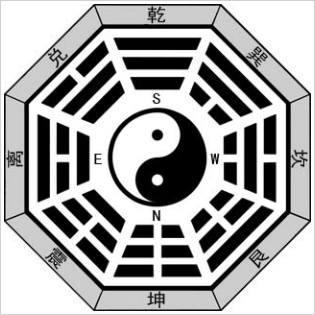
Welcome to my intro to I Ching! I have been using the I Ching for divination for many years now, and I want to share a beginner’s guide for anyone who wants to learn more but doesn’t know where to start. In the future, I’d love to dig into this more and discuss each Hexagram in detail!
The Lines
I ching is an ancient divination system that uses two different lines: The “broken” line represents “Yin” and the “whole” or un-broken line represents “Yang.”
You might be familiar with “Yin” and “Yang” from this famous symbol ☯️. But what do they represent? If you’re familiar with “female” and “male” symbolism from various esoteric traditions, this won’t be so foreign to you.
Yang represents male, heaven, positive, light, outward energy, and vigor.
Yin represents female, earth, negative, darkness, inward energy, and receptivity.
Now you might think, hey, why are females NEGATIVE! It’s important to remember that this symbolism is not saying anything about actual humans who identify as female or male. It’s more about the forces of nature both in a literal, tangible sense (storms, fire, etc) and a bigger picture sense (the cosmos, humanity, virtues) and how ancient people felt they could represent those forces with simplified symbols, such as female vs male or dark vs light.
It’s also good to note that “negative” or “dark” doesn’t necessarily mean “bad.” I think of it more as positively and negatively charged particles. Or the positive and negative exposures of a picture. Everything has a place, and the favorability of the outcome depends on whether this force, or virtue, or intention, is ideally placed and performing its appropriate function.
So we start with two lines:
— = Yang (positive, firm, unbroken)
– – = Yin (negative, soft, broken)
Initially, ancient Chinese people did readings with just two lines, with each possible combination having a different meaning. This is one of the reasons I Ching is so powerful–the way it developed organically and grew from a very simple concept into something more complex.
The ancient mystics then grouped these Yin and Yang lines into sets of 3, and later added those together to make 6.
The Trigrams
When you think of I Ching, you think of a little block with six lines. This is called a Hexagram. There are 64 hexagrams in all. If I Ching were a Tarot deck, the Hexagrams would be the 64 cards. But first we’re going to look at combinations of 3 lines, or Trigrams.
There are 8 Trigrams and they each have their own meaning, which plays into the meaning of the Hexagrams.
Mother, Father, Sons, and Daughter are, again, more symbolic than describing actual people.
The fist keyword after the name, such as “fire,” “heaven,” or “lake,” are the most helpful when visualizing the meanings of Hexagrams. For instance, Hexagram 9 is Sun (Wind) over Chien (Heaven.) The image of a light wind playing through the bright paradise of Heaven plays into the meaning of the Hexagram, which says that a light, gentle force can still have influence over the big, strong force of Heaven.
There is much more to the Trigrams! But this is a good starting place.
 | Ch’ien | Heaven | Creative | Strong | Father |
 | Chên | Thunder | Arousing | Inciting | 1st Son |
 | K’an | Water | Abyss | Danger | 2nd Son |
 | Ken | Mountain | Still | Resting | 3rd Son |
These three sons (and the three daughters) are sequential, telling a story beginning-to-end.
“The sons represent the principle of movement in its various stages–beginning of movement, danger in movement, and rest and completion in movement.” (Wilhelm/Baynes)
 | K’un | Earth | Receptive | Yielding | Mother |
 | Sun | Wood/wind | Gentle | Penetrating | 1st Daughter |
 | Li | Fire | Clinging | Inspiring | 2nd Daughter |
 | Tui | Lake | Joyous | Peaceful | 3rd Daughter |
“The daughters represent devotion in its various stages–gentle penetration, clarity and adaptability, and joyous tranquility.” (Wilhelm/Baynes)
You will see some female traits in supposedly “male” trigrams, such as The 2nd Son being The Abyss (negative, dark.) Being a Daughter or Son actually does not denote whether the Trigram, as a whole, has more “male” or “female” energy.
It might also seem strange that the Daughters have more Yang lines than Yin and vice versa. My understanding is that the Daughters show the progression of the single Yin line. Notice the 1st Daughter has a Yin line at the bottom. For the 2nd Daughter, the Yin line has progressed to the middle. And finally, for the 3rd Daughter, the Yin line has succeeded in reaching the top.
Same with the Sons, with the single Yang line starting at the bottom and making its way to the top.
I’m the type of person who likes to understand the “why” of things. So while I Ching oracles are very insightful, and sometimes it’s nice to just be told “this is what’s up.” When I cast my own I Ching Hexagrams, I like to break it down and think about all the elements at play.
Hopefully you will find this understanding of the Trigrams useful as you explore the 64 Hexagrams!
Leave a Reply